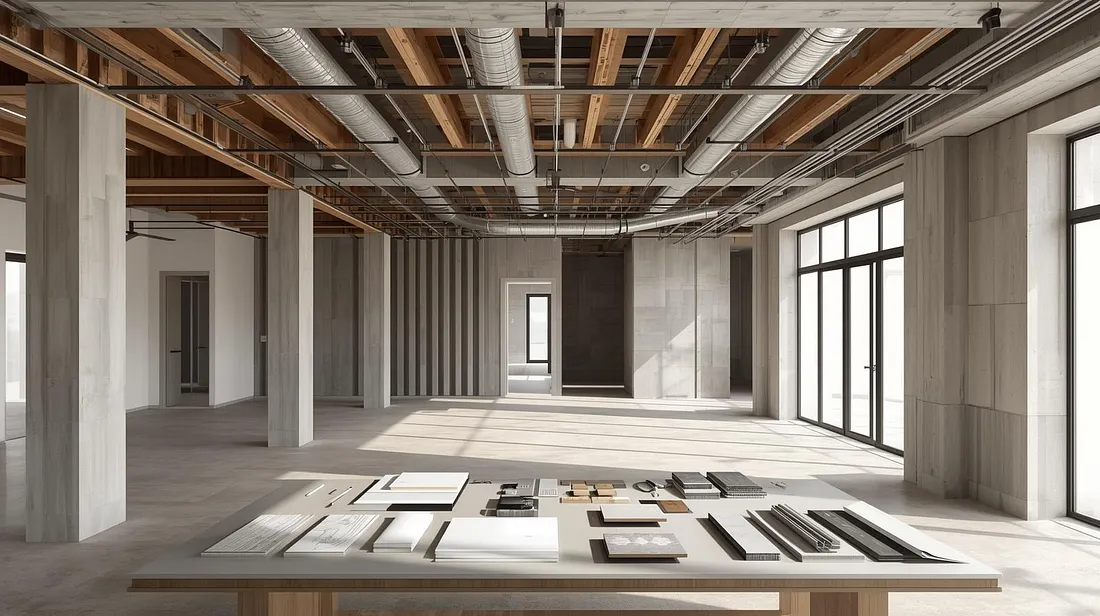
High-end residential construction is frequently associated with expanding budgets, prolonged timelines, and complex decision-making. These outcomes are often attributed to premium materials, bespoke detailing, or evolving client expectations. While such factors influence total cost, the most consistent and controllable cause of overruns is insufficient design coordination; the failure to align architecture, structure, building services, and interior systems into a single, resolved framework before construction advances.
Design coordination is not an aesthetic exercise. It is a technical, managerial, and financial discipline that determines whether a project proceeds with predictability or becomes reactive under pressure. In luxury housing, where precision, sequencing, and tolerances are significantly tighter than in standard construction, coordination directly governs whether expenditure remains controlled or escalates through rework and delay.
Understanding Coordination in Residential Architecture
Premium homes integrate multiple technical systems simultaneously:
- Architectural planning and spatial geometry
- Structural framing and load-bearing logic
- Mechanical, electrical, and plumbing (MEP) networks
- Interior architecture, joinery, and finishes
- Lighting, automation, façade, and landscape interfaces
Each system carries dimensional requirements, sequencing constraints, and installation tolerances. If these are resolved independently, conflicts emerge during construction. If resolved collectively, the project progresses in a continuous and measurable manner.
Design coordination therefore refers to the systematic integration of all disciplines into a coherent construction strategy before physical execution passes critical correction points. In financial terms, it is the difference between planned spending and reactive spending.
Where Cost Overruns Actually Begin
In high-end homes, overruns rarely originate from visible luxury upgrades. More often, they begin with late discovery of incompatibilities such as:
- Ceiling depths insufficient for duct routing
- Structural beams conflicting with lighting placement
- Inadequate wall thickness for concealed services
- Misaligned floor build-ups affecting door thresholds
- Waterproofing interfaces unresolved before finish selection
When such conflicts surface on site, correction requires demolition, redesign, and reinstallation. The project absorbs:
- Additional labour and supervision
- Material wastage and replacement
- Delayed sequencing of dependent trades
- Emergency procurement at premium pricing
These costs accumulate incrementally and are frequently misinterpreted as general “budget increase” rather than coordination failure.
Early Resolution as Financial Control
Effective coordination moves decision-making from the construction phase to the design phase, where changes are significantly less expensive. Key pre-construction coordination actions include:
- Verifying service routes within structural zones
- Aligning finished floor levels with drainage slopes and thresholds
- Integrating ceiling systems with lighting and HVAC layouts
- Testing joinery dimensions against wall tolerances
- Reviewing façade junctions for thermal and waterproof continuity
These activities require time, documentation, and interdisciplinary review. However, they convert uncertainty into defined scope, enabling accurate costing and procurement.
In luxury construction, money is rarely saved on site. It is saved through clarity before execution.
Integration Between Consultants and Contractors
High-value residences involve multiple specialised consultants. Without structured coordination, each discipline may optimise its own design without confirming compatibility with others. This fragmentation produces:
- Service diversions after structural completion
- Revised interior details following MEP installation
- Re-fabrication of bespoke components due to dimensional mismatch
- Variation orders issued to reconcile overlapping scopes
Coordinated projects instead establish:
- A single dimensional reference through consolidated drawings
- Clash-detection reviews before construction milestones
- Defined approval sequences linking design to procurement
- Clear responsibility boundaries between consultants and contractors
This structure reduces interpretation on site and stabilises both cost and schedule.
Timing and the Economics of Delay
Time overruns and cost overruns are closely linked. Delayed decisions create cascading financial consequences:
- Contractors price uncertainty with contingencies
- Urgent procurement increases material cost
- Trades require repeated mobilisation
- Extended supervision raises overhead expenditure
Design coordination mitigates these risks by ensuring construction begins only when information is sufficiently resolved to avoid reversal. Predictable sequencing enables:
- Planned procurement schedules
- Continuous labour deployment
- Reduced storage and protection costs
- Stable cash-flow forecasting
In economic terms, coordination protects the project from compound delay costs, which often exceed visible design upgrades.
Protecting Precision in High-End Detailing
Luxury architecture depends on dimensional accuracy and controlled tolerances. Flush alignments, recessed lighting, shadow gaps, and seamless material transitions require millimetre-level agreement between drawings and execution.
Without coordination:
- Ceiling levels drop to conceal unresolved services
- Trims replace intended flush joints
- Sealants compensate for misalignment
- Junctions shift from designed locations
Correcting these deviations post-installation is disproportionately expensive. Preventing them through coordinated detailing is therefore both a quality safeguard and a financial safeguard.
Coordination During Construction
Pre-construction integration alone is insufficient. Coordination must continue throughout execution via:
- Shop-drawing reviews confirming fabrication dimensions
- Material mock-ups validating junction detailing
- Site inspections verifying tolerance compliance
- Sequencing checks before closing concealed works
These controls ensure constructed reality matches coordinated intent. Without them, even well-resolved drawings cannot prevent cost escalation.
Variation Orders and Contractual Stability
Uncoordinated projects generate frequent variation orders; formal cost adjustments resulting from late design clarification or dimensional conflict. In bespoke luxury construction, such variations can be substantial.
Design coordination reduces variation by:
- Finalising specifications before tender
- Limiting provisional quantities
- Clarifying interface responsibilities
- Providing measurable construction information
This stabilises contracts, reduces disputes, and maintains predictable financial planning.
Lifecycle Cost Beyond Handover
Coordination influences not only construction cost but also long-term performance. Poorly integrated systems may lead to:
- Leakage from unresolved waterproofing interfaces
- Cracking due to structural-finish incompatibility
- Inefficient mechanical performance
- Premature material deterioration
Rectification in occupied luxury homes is significantly more expensive than prevention during construction. Coordination therefore contributes to lifecycle cost efficiency, not merely initial budget control.
Governance and Decision Frameworks
Successful high-end projects implement formal coordination governance, including:
- Scheduled interdisciplinary review meetings
- Revision-controlled drawing documentation
- Defined approval hierarchies
- Change-management protocols linking design revision to cost impact
Such governance transforms coordination from informal discussion into a traceable management system, enabling informed financial decisions and accountability.
Conclusion: Coordination as the Core Cost-Control Mechanism
Cost overruns in high-end homes are rarely inevitable consequences of luxury. They are typically the result of decisions made too late, in isolation, or without dimensional certainty.
Design coordination addresses this by:
- Aligning disciplines before construction
- Stabilising time, procurement, and labour deployment
- Preserving precision in architectural detailing
- Minimising contractual variation and lifecycle defects
The most financially efficient luxury homes are not those that reduce ambition.
They are those in which every component is resolved in relation to the others before execution begins.
When alignment is achieved, cost becomes predictable, construction becomes continuous, and architectural intent is delivered without compromise.
This is the practical function of design coordination
and the primary reason it remains indispensable in the delivery of high-end residential architecture.