In luxury residential construction, procurement is often treated as an administrative function, a sequence of purchase orders triggered once drawings are finalised. But when working with long-lead natural materials, procurement is not clerical. It is architectural strategy.
Timing determines outcome.
Unlike manufactured finishes that can be reordered with predictable uniformity, natural materials operate within geological constraints. They are extracted, cut, and distributed in finite quantities. Each block carries variation. Each slab is singular. Once processed, it cannot be recreated.
This reality changes the rhythm of decision-making.
Block Selection: Decisions at the Source
For significant installations like expansive flooring, monolithic staircases, large-format wall cladding, selection ideally begins at the quarry or block level. Blocks vary in veining density, tonal balance, structural integrity, and yield potential. Waiting until slabs reach the fabrication yard reduces influence over final outcome.
Block selection is not aesthetic indulgence. It is risk control.
Selecting early allows design teams to align layout geometry with natural movement in the material. Veins can be oriented intentionally. Book-matching opportunities can be evaluated realistically. Structural soundness can be confirmed before cutting begins.
Delaying this step compresses control.
When procurement begins late, teams are often forced to work from available slab inventory rather than ideal geological yield. Design adapts to stock instead of material being sourced to design.
In high-end architecture, that reversal subtly compromises clarity.
Quarry Variation and Supply Windows
Natural materials are subject to extraction cycles. Quarry output fluctuates based on environmental conditions, regulatory approvals, and seasonal access. Certain quarries operate intermittently. Others close temporarily due to block depletion.
A material available today may not be available in six months.
Procurement timing must account for these windows. Early engagement with suppliers allows forecasting of extraction schedules and reservation of specific blocks. Late engagement increases the risk of batch variation or substitution.
In long-cycle homes where continuity is paramount, this variability cannot be ignored.
Slab Booking and Allocation
Once blocks are cut into slabs, allocation becomes critical. Slabs from the same block ensure visual continuity. Slabs from adjacent blocks may introduce subtle tonal shifts. For large residences, especially those requiring continuous flow between spaces, booking sufficient slabs from a single source becomes essential.
This requires commitment.
Slabs must often be reserved and held before fabrication begins. Storage logistics, payment structures, and insurance considerations enter the conversation. Procurement timing therefore intersects with financial planning.
Waiting until installation approaches may result in fragmented sourcing, slabs collected from multiple batches, reducing uniformity across major surfaces.
Early booking protects cohesion.
Fabrication Lead Times
Fabrication for dense natural materials is not instantaneous. Large-format slabs require careful cutting, reinforcement backing where necessary, edge finishing, polishing, and quality inspection. Complex geometries like curved staircases, mitred edges, monolithic islands, extend fabrication timelines further.
Shipping adds additional layers. International transport, customs clearance, inland logistics, and on-site handling must be sequenced precisely.
If procurement begins only after structural completion, schedule pressure intensifies. Fabricators may rush processing. Installation windows narrow. Quality control can suffer.
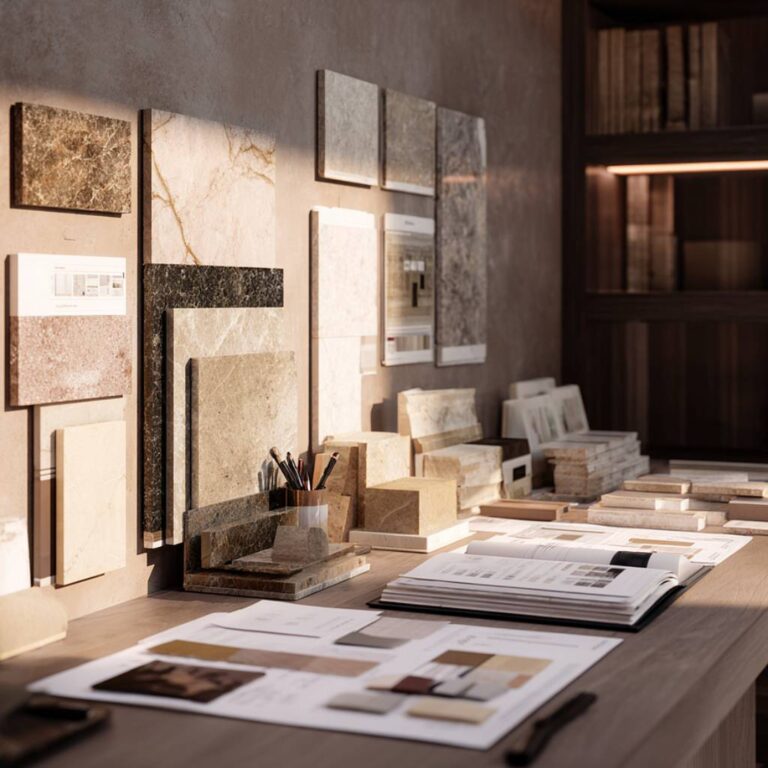
When procurement is aligned with early design phases, fabrication can proceed deliberately. Samples can be approved without haste. Edge details can be refined before bulk production.
Time, in this context, becomes a quality tool.
Design Integration and Layout Planning
Long-lead natural materials demand early dimensional certainty. Layout decisions influence slab yield. Joint lines affect visual flow. Structural tolerances determine cutting allowances.
If procurement is delayed, layout decisions may be forced to accommodate material constraints. If procurement is advanced, material geometry informs layout intelligently.
The direction of influence matters.
In refined architecture, design should lead procurement, but procurement must be initiated early enough to respond to design intent fully.
Financial Implications of Timing
There is also economic logic to early procurement. Reserving material early stabilises pricing in volatile markets. It reduces exposure to sudden quarry closures or extraction slowdowns. It protects against inflationary shifts in transport costs.
Conversely, late procurement may involve premium pricing for limited stock or expedited shipping. Batch inconsistency may require aesthetic compromise or costly replacement.
Multi-decade homes cannot afford short-term procurement thinking.
The Discipline of Early Commitment
The hesitation to commit early often stems from fear of locking decisions prematurely. Yet long-lead natural materials demand confidence in direction. Their very nature resists last-minute alteration.
This is not a limitation. It is a design discipline.
Committing early encourages clarity in layout, geometry, and detailing. It forces alignment between architecture, engineering, and fabrication teams. It reduces improvisation later in the construction cycle.
When procurement becomes strategic rather than reactive, material performance improves.
The Final Bridge
As projects transition from general material discussions to more specific selections, procurement timing becomes the decisive variable. It is the bridge between concept and execution.
Long-lead natural materials reward foresight. They respond to early coordination, careful booking, and disciplined scheduling. They penalize delay and improvisation.
In high-end homes intended to endure across generations, foundational materials deserve foundational planning.
Procurement, when understood properly, is not purchasing. It is protection.
Protection of continuity. Protection of geometry. Protection of long-term integrity.
And in luxury architecture, integrity is rarely achieved by accident.