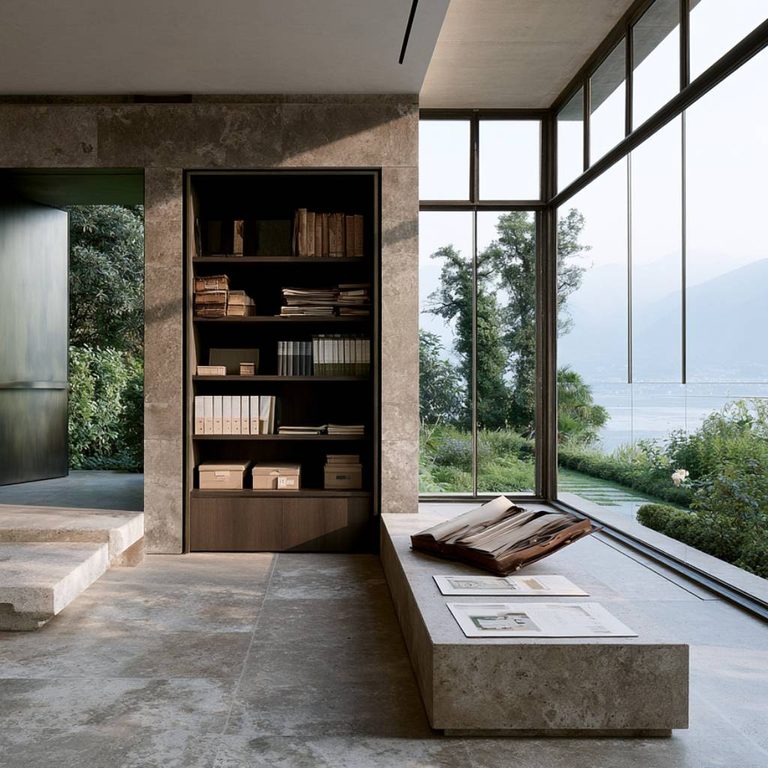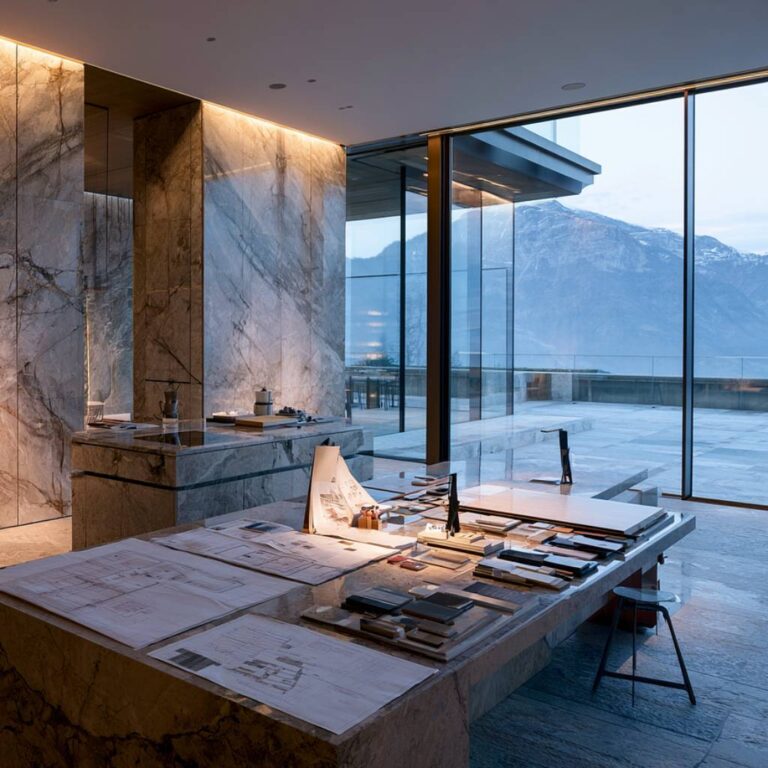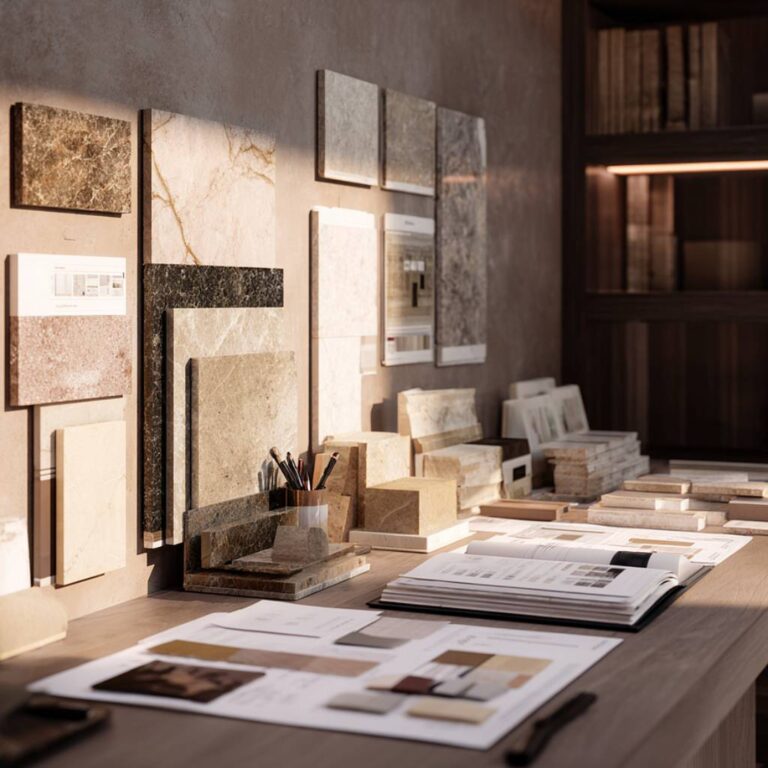
In luxury residential architecture, surface selection is often framed as a matter of taste. Veining, tone, uniformity, finish, and texture dominate the conversation. Yet in high-traffic zones, aesthetics are only the beginning. What ultimately defines success is performance.
The real debate is not natural versus engineered as a matter of preference. It is a question of behaviour under stress.
Entry foyers, living corridors, kitchens, transitional thresholds, and outdoor spillover areas impose daily friction. Grit travels in. Furniture shifts. Heat fluctuates. Sunlight strikes. Liquids spill. These zones operate under constant abrasion and environmental exposure. Surface selection here must move beyond visual alignment and confront physical reality.
This is where the intellectual battleground begins.
Scratch Resistance: Hardness vs Repairability
Scratch resistance is often treated as a binary metric, either a surface scratches or it does not. In practice, the conversation is more nuanced.
Engineered surfaces are typically designed for high surface hardness and uniform density. Many resist superficial abrasion well, especially in controlled interior environments. Their homogeneity can limit visible surface disruption from minor contact.
Natural materials vary. Their performance depends on mineral composition, density, and finish. Some stones exhibit high compressive strength and perform exceptionally in high-traffic conditions. Others are softer and develop surface marks more readily.
Yet scratch resistance must be evaluated alongside repairability.
Engineered surfaces that chip or scratch deeply may require panel replacement, particularly when patterns are printed or layered beneath a top coat. Seamless visual continuity can be difficult to restore invisibly.
Natural materials, depending on thickness and installation method, often allow for refinishing or localized honing. Surface marks can become part of a gradual patina rather than isolated defects.
The question is not which surface scratches less in theory. It is which surface manages wear more intelligently over time.
Heat Tolerance: Chemical Stability Under Stress
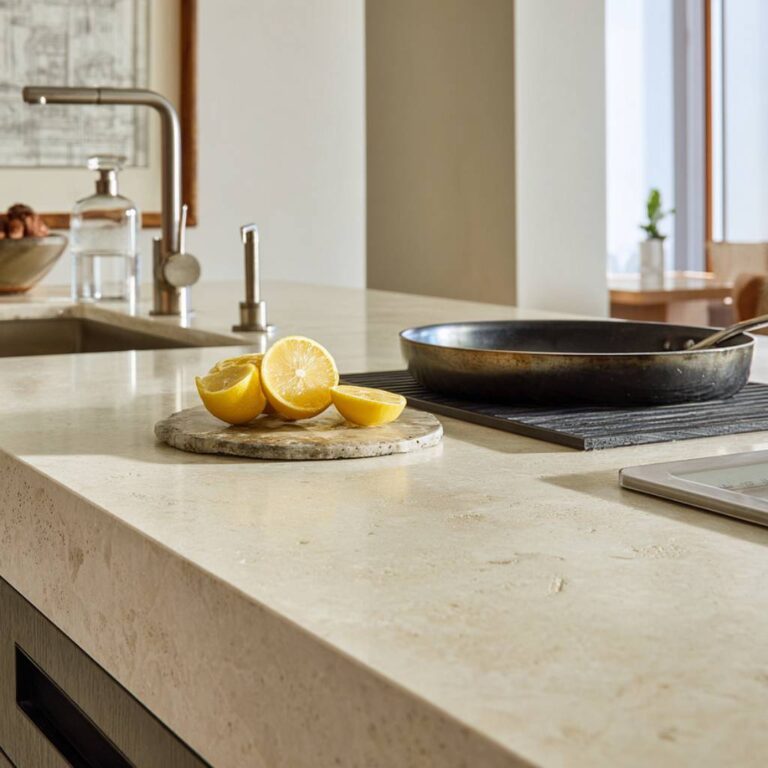
Kitchens represent one of the most demanding interior zones. Direct heat from cookware, thermal shock from rapid temperature shifts, and chemical exposure from food acids introduce complex performance variables.
Engineered materials often rely on resins or binding agents to achieve consistency. While many are heat resistant within specified tolerances, extreme temperature exposure can compromise bonding layers or create discoloration.
Natural stone, by contrast, is formed under geological heat and pressure. Dense varieties generally exhibit strong heat tolerance, making them inherently stable under direct thermal exposure. However, certain finishes may still react to prolonged heat or rapid shock.
The distinction lies not in marketing claims but in material composition. In high-traffic kitchens, the ability of a surface to withstand both heat and chemical interaction without structural degradation becomes critical.
A surface that performs visually but requires protective behaviour from occupants may not align with the expectations of a high-use environment.
UV Stability: Colour Over Time
Large-format glazing has redefined luxury interiors. Expansive glass walls introduce daylight deep into living spaces, but they also introduce ultraviolet exposure.
Engineered surfaces, particularly those incorporating pigments or printed patterns, may experience colour shifts over prolonged UV exposure. Even minor fading becomes perceptible in seamless installations where uniformity is central to the aesthetic.
Natural materials carry inherent colour variation through mineral composition rather than applied pigmentation. While certain stones can lighten subtly over time, their character is less dependent on surface coatings.
In high-traffic zones adjacent to glazing, UV stability determines whether a surface maintains continuity or develops uneven tonal change.
The performance question becomes long-term visual integrity rather than immediate finish quality.
Repairability: Replacement vs Restoration
Perhaps the most overlooked variable in high-traffic zones is repairability.
No surface is immune to impact. Furniture legs drag. Objects drop. Corners chip. The issue is not whether damage occurs, but how it is addressed.
Engineered materials often require sectional replacement when significant damage occurs. Achieving batch consistency months or years later can present logistical challenges. Installation seams may become visible if panels are swapped.
Natural materials, particularly those installed with adequate thickness, can sometimes be refinished in situ. Localized honing or polishing may restore continuity without full replacement. In certain contexts, minor imperfections become part of the surface’s evolving character rather than a reason for intervention.
Repair strategy influences lifecycle cost. A material that performs well initially but is difficult to restore may generate higher long-term disruption.
Uniformity vs Variation
Engineered surfaces offer predictable uniformity. For certain design languages, this consistency is advantageous. Large, uninterrupted expanses with minimal tonal deviation can create visual calm.
Natural materials introduce inherent variation. Veining, movement, and mineral shifts create individuality across slabs. In high-traffic zones, this variation can either conceal wear through visual complexity or amplify contrast depending on selection.
The choice becomes philosophical. Uniformity prioritises control. Variation prioritises authenticity.
In performance terms, uniform surfaces may show localized damage more clearly, while varied surfaces may diffuse visual focus across natural patterning.
Structural Interaction
Beyond surface characteristics lies structural interaction. Rigid materials respond directly to substrate movement. High-traffic zones are frequently located near structural transitions like entries, thresholds, and long spans.
Material density, flexibility, and installation method influence how surfaces interact with deflection and expansion. Engineered materials may exhibit slightly different tolerance behaviour compared to dense natural slabs. However, both require disciplined substrate preparation and movement planning.
Performance is never isolated to the material alone. It is a system.
The Trade-Off Framework
Selecting surfaces for high-traffic zones is not about declaring one category superior. It is about aligning performance variables with behavioural realities.
Scratch resistance must be weighed against repair strategy.
Heat tolerance must be measured against actual usage patterns.
UV stability must be evaluated relative to glazing exposure.
Uniformity must be balanced against ageing character.
Luxury is no longer defined solely by initial visual impact. Increasingly, it is defined by endurance, that is how surfaces behave after years of occupation.
The most intelligent decisions acknowledge trade-offs openly rather than pursuing idealized perfection. A material that performs exceptionally in one dimension may require compromise in another. The role of the architect is not to eliminate compromise, but to position it consciously.
High-traffic zones are unforgiving teachers. They reveal whether surface selection was driven by aesthetics alone or by technical understanding.
In the end, the comparison between natural and engineered surfaces is not ideological. It is contextual.
Performance defines luxury more reliably than polish.
And in high-traffic environments, performance always speaks last.