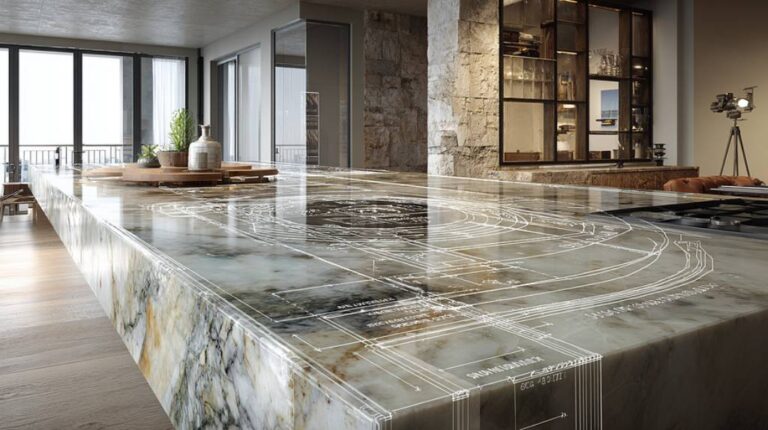
In luxury homes, the most serious failures rarely begin with the materials that are visible. They begin quietly beneath the surface, inside the concealed layers that manage water over time. Bathrooms, balconies, and terraces may appear complete once stone or tile is installed, yet their true performance depends on what lies below; slopes, membranes, screeds, joints, and curing sequences working together as a single system. When even one of these layers is misunderstood or rushed, the damage does not appear immediately. It surfaces much later, often after the home is fully occupied, when repair becomes complex, expensive, and emotionally draining.
This delayed visibility is what makes wet areas uniquely deceptive. A faint stain in marble, a hairline crack in grout, or a damp mark on the ceiling below rarely signals a recent mistake. Instead, it reveals a decision made weeks or months earlier during construction. By the time the symptom becomes visible, the true cause is already buried under finished layers. In this sense, waterproofing is not simply a technical precaution. It is a form of long-term architectural protection.
Understanding wet areas therefore requires a shift in thinking. These spaces are not defined by their finishes but by their build-up. What appears to be a simple bathroom floor is in reality a carefully ordered vertical sequence in which each layer has a precise responsibility. The structure provides stability, the screed creates slope, the membrane blocks moisture, protective layers prevent puncture, and the final finish offers durability and visual calm. Failure occurs when these responsibilities blur, when slope is attempted too late, when curing is shortened, or when testing is ignored in the urgency to complete visible work.
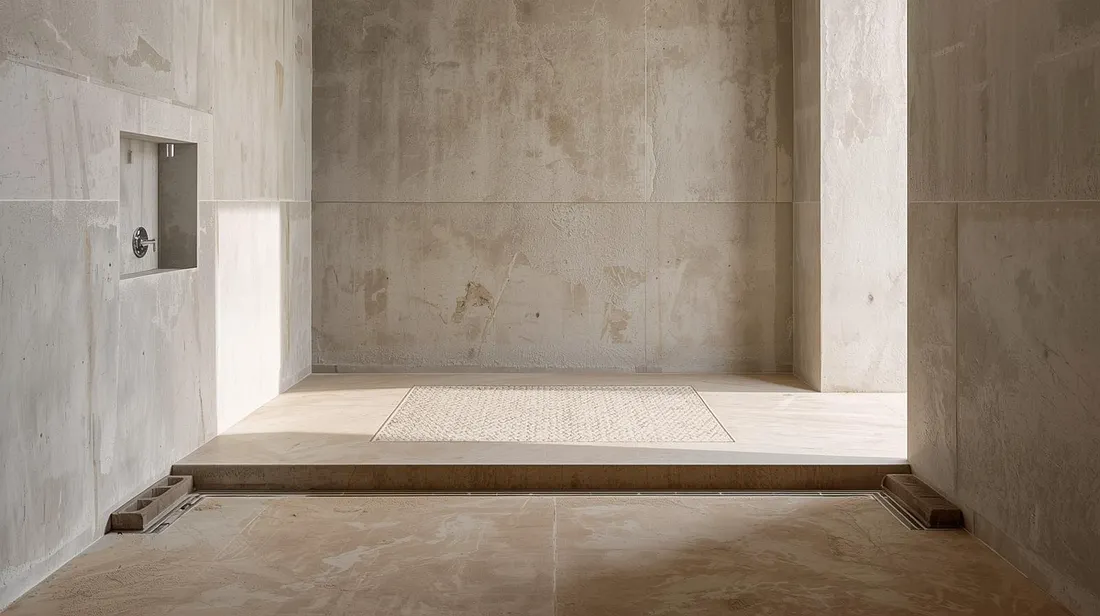
Among all hidden factors, slope remains one of the most quietly important. Water does not require dramatic design errors to cause damage. A difference of only a few millimetres across a surface can allow slow pooling that goes unnoticed in daily use. At first, this standing moisture appears harmless, perhaps only darkening stone slightly or leaving faint mineral traces. Over time, however, the same moisture begins to migrate through joints and microscopic openings, gradually weakening adhesives and staining finishes. What could have been resolved through early geometric precision becomes a long-term maintenance burden. True luxury in wet areas therefore begins not with the membrane or the tile but with the accuracy of the surface beneath them.
Equally misunderstood is the role of time in waterproofing. Conversations often focus on the type of membrane or the reputation of a product, yet site failures more often result from incomplete curing or disrupted sequence. Liquid membranes require uninterrupted drying between coats, while sheet systems depend on careful sealing at edges and junctions. When construction schedules compress these durations, the membrane may appear complete while remaining structurally vulnerable. The consequences again unfold slowly, through adhesion loss or hairline cracking that only later affects the finish above. What seemed like saved time during construction ultimately becomes multiplied time during repair.
Testing is the moment when hidden certainty can still be achieved, yet it is also the step most frequently shortened or skipped. Holding water within a completed wet area before installing finishes is a simple act, but it reveals whether the system truly performs. When this confirmation is omitted, leaks remain undiscovered until demolition becomes the only remedy. At that stage, the cost is no longer technical but emotional, because finished spaces must be undone. Proper testing does not add visible value, yet it quietly preserves everything that follows.
The behaviour of premium stone in wet zones illustrates this relationship between hidden systems and visible outcomes. Natural stone is often assumed to fail when staining or detachment appears, but in most cases the material is only responding to moisture conditions created below it. Because stone is porous and sensitive to trapped dampness, even small imperfections in waterproofing or substrate stability become visible at its surface. Two homes using identical marble can therefore age very differently. The distinction lies not in the stone itself but in the unseen construction beneath it.
Exterior wet areas introduce an additional layer of complexity. Balconies and terraces must respond not only to water but also to sunlight, temperature change, and structural movement. Expansion and contraction place continuous stress on membranes and joints, making detailing far more demanding than in interior bathrooms. Movement joints, protected edges, reliable drainage, and flexible sealants become essential rather than optional. Without them, even well-installed waterproofing can deteriorate prematurely. Exterior wet areas reveal that durability is never a single decision but a coordinated anticipation of forces over time.
Construction discipline ultimately determines whether design intent survives reality. Finishes installed before screeds fully dry, membranes punctured by later trades, or drainage paths blocked by debris are small moments on site that carry large consequences in the future. Luxury construction is often evaluated through what is seen at completion, yet wet-area performance is decided long before that moment. The difference between endurance and failure is rarely dramatic. It is usually the accumulation of small neglected details.
When waterproofing is treated as an afterthought, maintenance becomes inevitable. When it is treated as architecture, failure becomes rare. This distinction transforms the design conversation. Instead of asking which finish appears most refined, the deeper question becomes which hidden build-up will allow that finish to endure unchanged over years of use. In this way, wet-area detailing moves from background technicality to central design responsibility.
True luxury in bathrooms, balconies, and terraces is therefore quiet. It is not expressed through ornament or rarity of material but through the confidence that surfaces will remain stable, dry, and calm long after construction ends. Slopes formed with precision, membranes cured with patience, joints tested with care, and substrates prepared with discipline create conditions in which expensive finishes no longer need to defend themselves. They are free simply to exist and age gracefully.
This reveals a final architectural truth. Premium materials do not fail on their own. They fail when the systems beneath them are misunderstood. Waterproofing, though invisible, is the layer that allows visible beauty to persist. In protecting what cannot be seen, it ultimately protects everything that can.