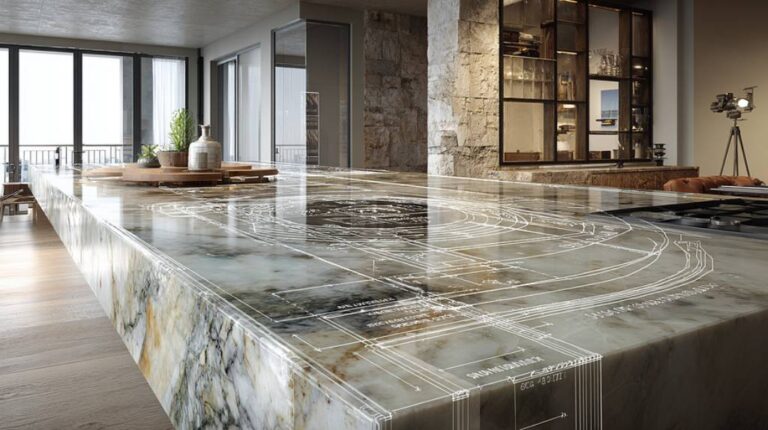
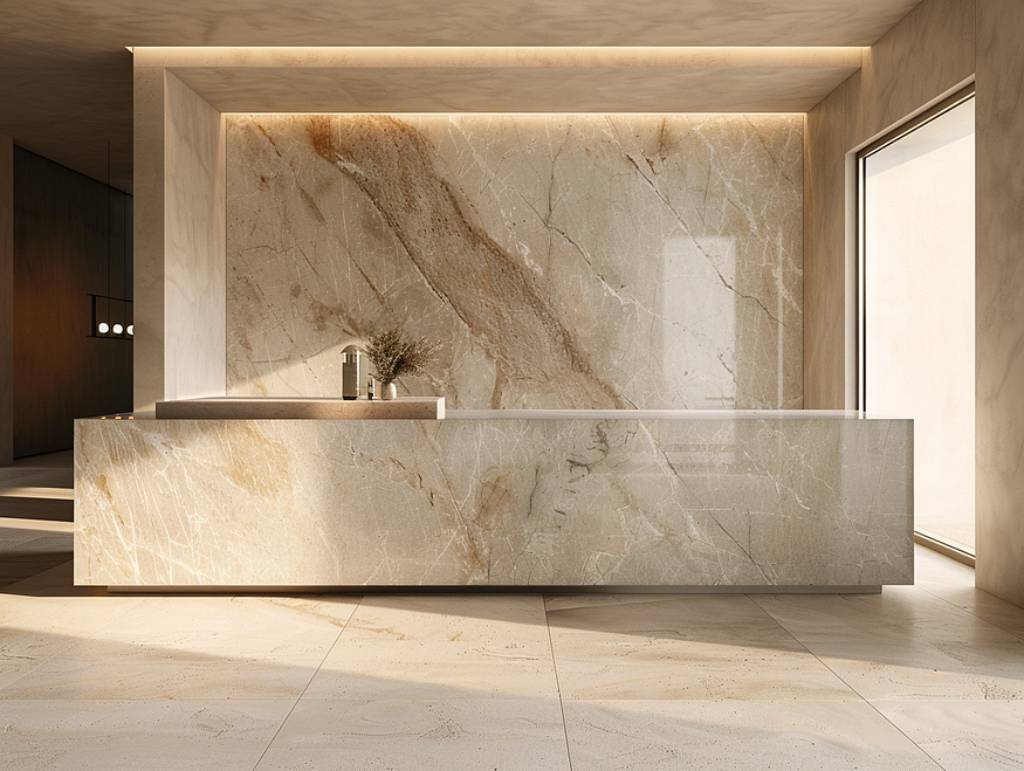
Luxury homes are often designed as if materials can be selected at the end.
They cannot. Especially not natural stone.
Stone is not a surface you “pick later.” It is a long-lead system that quietly locks in:
- junction dimensions
- substrate strategies
- procurement timelines
- installation tolerances
When treated as a finish, it fails. When treated as a package, it defines the project.
The Misconception: Stone as a Visual Choice
Most projects approach stone selection as a visual exercise.
A slab is chosen after layouts are fixed. Details are resolved after structure is complete.
Installation becomes reactive.
This sequence introduces risk at every stage:
- misaligned joints
- inconsistent levels
- excessive wastage
- compromised design intent
The issue is not material quality.
The issue is decision timing.
The Reality: Stone as a System
In high-end homes, stone is not a layer, it is a system embedded into the project timeline.
It interacts with:
- structural tolerances
- waterproofing layers
- edge conditions
- lighting alignment
- adjacent materials
This means one thing:
The moment you decide to use stone, you are no longer making a finish decision.
You are initiating a sequence of coordinated decisions.
The Stone Package Timeline
To maintain design integrity, stone must follow a structured decision-gate schedule.
STONE PACKAGE DECISION-GATE SCHEDULE
1. Concept Intent
Define zones, applications, and performance requirements.
(Where, why, and how stone is used, not which slab.)
2. Slab Shortlisting
Identify materials based on use-case, not aesthetics alone.
Availability, size, and variation are evaluated early.
3. Layout Workshop
Bookmatching, grain direction, joint alignment.
This stage determines visual continuity.
4. Shop Drawings
Precise detailing of cuts, edges, junctions, and tolerances.
This locks coordination with other systems.
5. Site Readiness Audit
Levels, substrates, waterproofing, and alignments verified.
No installation begins without this checkpoint.
6. Installation
Executed within defined tolerances and sequence.
7. Handover + Care Strategy
Maintenance, sealing, and long-term performance defined.
The Hidden Layer: Pre-Installation Verification
One of the most overlooked stages is the site audit before installation.
This is where projects either protect or compromise their outcome.
A proper audit includes:
- substrate flatness checks
- moisture level verification
- alignment validation with adjacent finishes
- readiness of edge conditions
Without this, even the best material will fail.
Why This Matters
Luxury is not defined by the material itself.
It is defined by:
- how early decisions are made
- how systems are coordinated
- how risks are controlled before execution
Stone simply exposes whether this discipline exists.
The Real Definition of Precision
In well-executed homes, nothing about stone is accidental.
- joints align with intent
- surfaces remain level across transitions
- patterns are continuous, not forced
- installation appears effortless
This is not craftsmanship alone. This is sequencing intelligence.
Natural stone carries geological time into a built space.
But its performance is entirely dependent on human decisions made over weeks.
When treated as a late-stage choice, it becomes fragile. When treated as a system, it becomes permanent.
The difference is not in the stone. It is in when and how you decide.