There is a persistent belief in construction and interior projects that quality is something achieved during installation. It is a convenient belief because it places responsibility at the final stage, where the work is most visible. But in reality, installation is not where quality is created, it is where quality is revealed. By the time stone reaches site, most of the decisions that determine its performance have already been made. Dimensions have been fixed, joints have been defined, substrates have been prepared, and sequences have been set in motion. What happens on site is not creation, but execution. And execution, no matter how skilled, cannot compensate for decisions that were incomplete or unverified upstream. This is why high-performing projects do not rely on installation to achieve quality; they rely on a system of gates that ensure quality is already embedded before installation begins.
The concept of quality gates is borrowed from disciplines where failure is not an option. In these environments, no process advances without passing through defined checkpoints. Each checkpoint exists to answer a simple but critical question: is the system ready to move forward without introducing risk? In construction, however, these checkpoints are often informal or compressed. Drawings are approved quickly, materials are ordered under time pressure, and installation begins with the assumption that readiness exists. This assumption is where most failures originate. A gate-based approach replaces assumption with verification. It introduces deliberate pauses in the workflow where alignment is tested across design, fabrication, and site conditions. These pauses are not delays; they are controls.
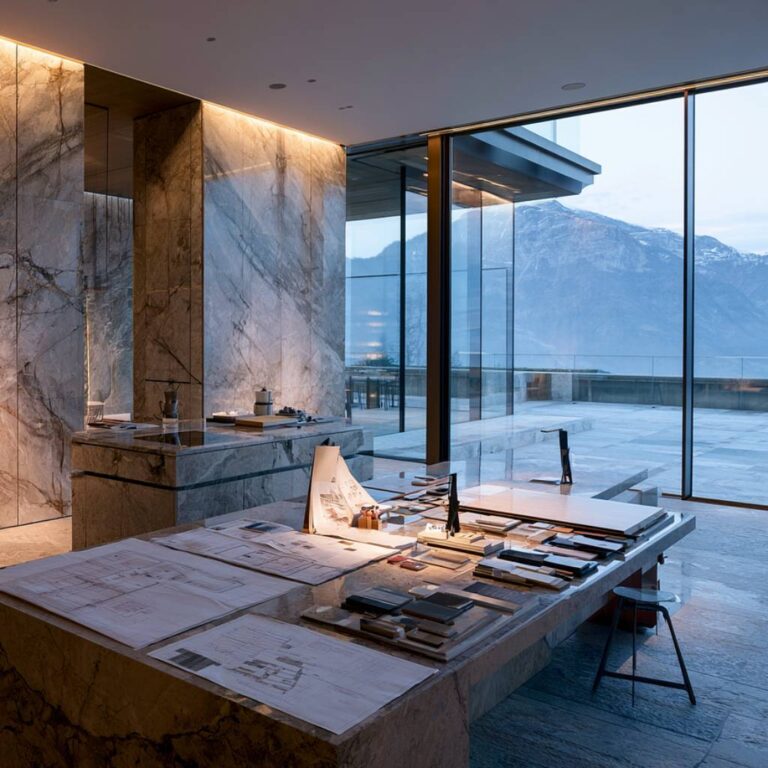
The first gate, design sign-off is often misunderstood because it is treated as a visual or aesthetic approval. A drawing is reviewed, agreed upon, and marked as complete. But completeness in design is not about appearance; it is about translatability. A design is only ready when it can move into fabrication without ambiguity. This requires more than dimensions on paper. It requires a clear definition of joint logic, module coordination, edge conditions, and transition details. It requires mapping and understanding how each piece will be cut, oriented, and installed. In stone work, where pattern continuity and grain direction matter, mapping is not an optional layer; it is fundamental to the outcome. When drawings are signed without this level of resolution, the burden shifts to the fabricator and installer. They are forced to interpret intent, and interpretation introduces variability. Variability, in turn, erodes consistency. The design gate, therefore, is not simply about agreement but it is about removing the need for interpretation altogether.
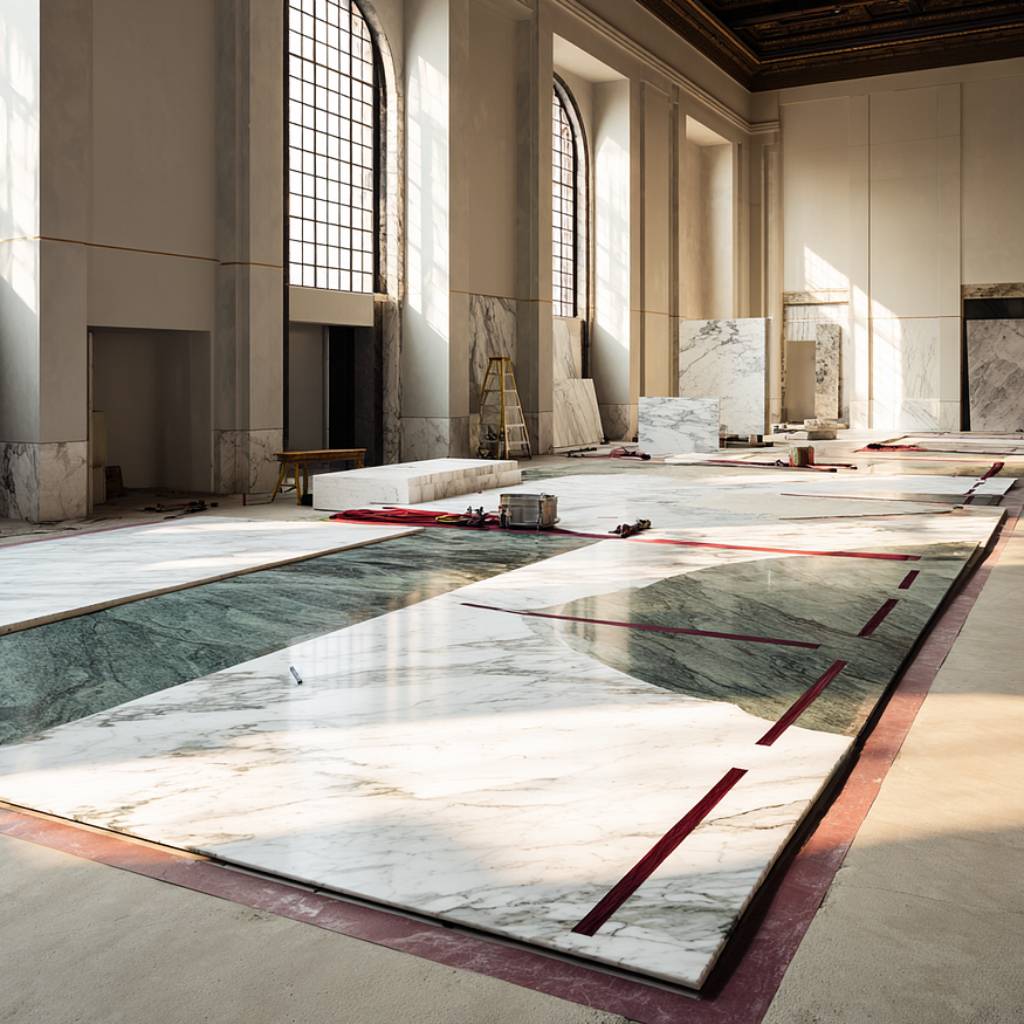
Once design intent is fully resolved, the project moves into the second gate: site readiness. This is the least visible and often the most underestimated stage, yet it carries the highest technical risk. Site readiness is not a checklist of superficial conditions; it is a verification of the substrate and environment that will support the finish. For stone installations, this includes flatness within defined tolerances, moisture content within acceptable limits, and compatibility between layers such as screeds, waterproofing systems, and adhesives. These conditions are not negotiable. When installation begins on a substrate that is “almost ready,” the installer compensates. Adhesive beds are adjusted, levels are forced, and alignments are corrected manually. These compensations may solve immediate problems, but they introduce stresses into the system. Over time, these stresses manifest as lippage, hollow sounds, cracking, or detachment. The failure does not appear at the moment of installation; it appears weeks or months later, when the system begins to respond to use and environmental conditions. A formal site readiness gate prevents this by ensuring that installation begins only when conditions are correct, not when schedules demand progress.
The third gate, finish acceptance is where the project is validated, but it is also where many projects fall short. Acceptance is often reduced to a visual inspection: the surface looks aligned, the joints appear consistent, and the finish seems uniform. While these observations are necessary, they are insufficient. A robust acceptance process must include measurable criteria. Joint widths must fall within defined tolerances, surface levels must meet specified limits, and adhesion must be verified beyond visual confirmation. Edge conditions and transitions must align with the original design intent. Without these checks, acceptance becomes subjective, and subjectivity allows defects to pass through unnoticed. Once a project moves beyond this stage, corrections become disruptive and expensive. Stone may need to be lifted, replaced, or reworked, often affecting adjacent finishes. The acceptance gate is, therefore, not a formality; it is the final control point where quality is either confirmed or compromised.
What makes these gates effective is not their individual strength, but their interdependence. Each gate builds on the previous one. A perfectly prepared site cannot compensate for an unresolved design, and a well-executed installation cannot correct a flawed substrate. When these gates are treated as isolated checkpoints, their effectiveness diminishes. When they are treated as a system, they create a continuous chain of verification. The output of the design gate becomes the input for site readiness. The output of site readiness becomes the foundation for installation. The output of installation is then validated at acceptance. This continuity is what transforms a linear workflow into a controlled process.
There is also a misconception that introducing such rigor slows down projects. In practice, the opposite is true. Time invested in structured verification reduces the need for correction later. Problems addressed at the design stage are easier and less expensive to resolve than those discovered during installation. Similarly, ensuring site readiness before installation prevents delays caused by rework. Instead of firefighting issues on site, teams move forward with clarity. Contractors work with defined parameters, fabricators produce with confidence, and clients experience fewer disruptions. The project timeline becomes more predictable because variability is reduced.
In luxury projects, the importance of this approach is amplified. High-value materials do not tolerate inconsistency. A minor deviation that might go unnoticed in standard finishes becomes immediately visible in stone. A misaligned joint, an uneven edge, or a subtle variation in level can disrupt the entire composition. More importantly, the cost of correction is significantly higher. Replacing or reworking stone is not only expensive but also time-consuming and often invasive. This is why luxury is not simply about material selection; it is about process control. The perception of quality is built on the consistency of execution, and consistency can only be achieved through disciplined systems.
At its core, the idea of installation quality gates reframes how projects are approached. It shifts the focus from reacting to problems to preventing them. It recognizes that quality is not an outcome of effort alone, but of timing, making the right decisions, at the right stage, with the right level of verification. By the time installation begins, the outcome should already be determined. The role of the installer is not to resolve uncertainty, but to execute clarity.
Luxury, in this context, is not defined by what is installed, but by how the process was controlled before installation began. It is the result of decisions that were checked, conditions that were verified, and sequences that were respected. When these elements align, installation becomes predictable, and predictability is the foundation of quality. What appears on the surface as a flawless finish is, in reality, the visible expression of a system that worked exactly as it was intended to.