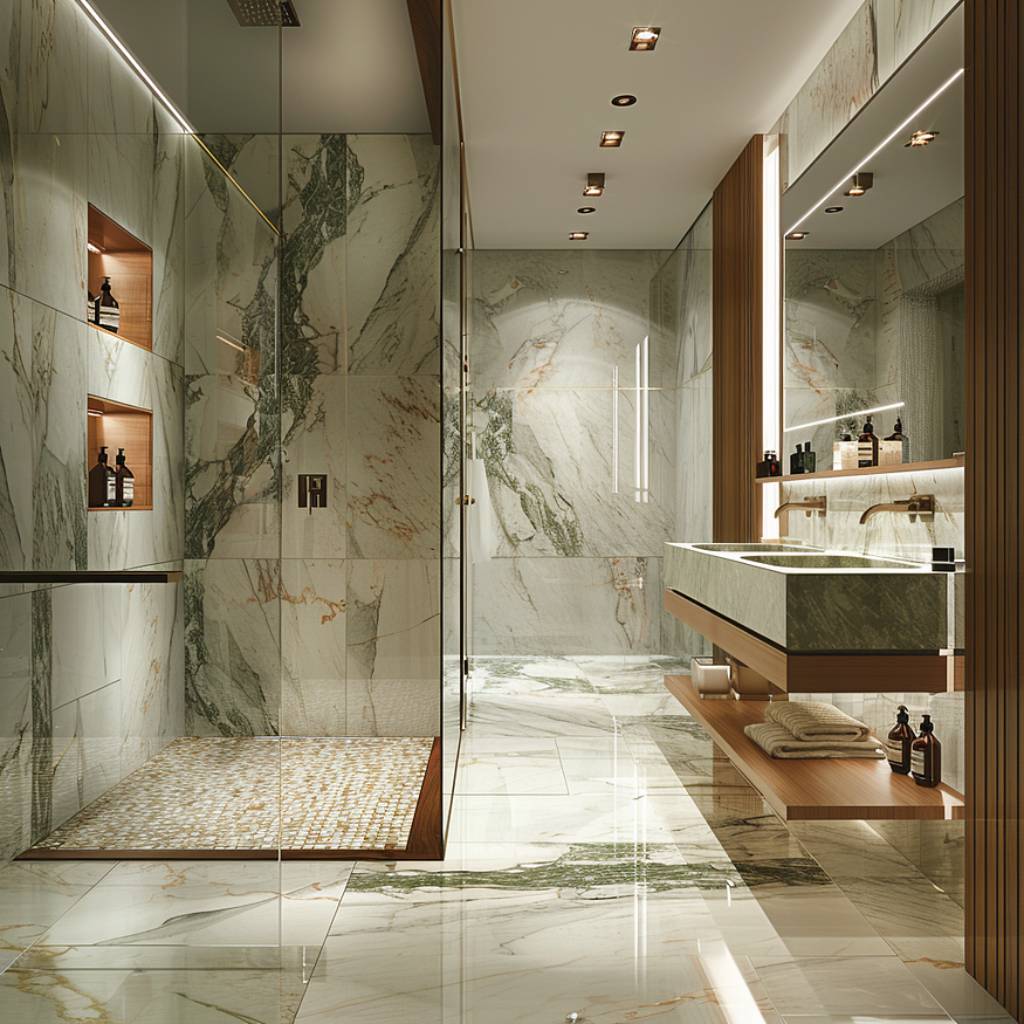
A luxury shower floor can look flawless on day one perfectly aligned stone, tight joints, and a polished finish that signals quality. Yet weeks later, dark patches begin to appear, uneven and stubborn, resisting cleaning and slowly spreading. The instinctive reaction is to question the material: Was the stone too porous? Was it poorly sealed? Was it the wrong selection? But in most cases, the stone is not the problem. The staining is not a surface defect; it is a symptom of a deeper issue within the assembly.
The First Misdiagnosis: Blaming the Stone
When dark patches appear, they rarely behave like typical stains. They deepen after use, lighten slightly when dry, and return again with moisture exposure. This pattern is critical. It indicates that what you are seeing is not dirt or residue sitting on the surface but moisture moving through the stone from below. The stone is acting as a visual indicator, revealing conditions within the system rather than failing on its own.
What’s Really Happening: Moisture Trapped in the System
Beneath every stone floor in a wet area lies a layered assembly substrate, waterproofing, adhesive, and finally the stone itself. If any part of this system fails to manage water correctly, moisture begins to accumulate. The most common breakdown occurs at transitions: around drains, at corners, and along membrane terminations. These are the weakest points in execution, and once covered, they are no longer visible or accessible.
Without a consistent slope directing water toward the drain, moisture does not evacuate efficiently. Instead, it lingers within the system, creating pockets of saturation. Over time, this trapped moisture begins to migrate upward. Natural stone, even when sealed, is not fully impermeable. It responds to moisture conditions beneath it. Areas with higher moisture content appear darker, creating the irregular staining pattern often mistaken for surface damage.
Artifact 1: How Moisture Moves Through the Assembly
Think of the system as a controlled pathway for water. When that pathway is broken by poor slope, incomplete waterproofing, or blocked drainage water doesn’t disappear. It stays within the assembly and eventually expresses itself through the surface.
Why Premium Stone Makes It More Visible
Ironically, higher-end stone often makes the problem more noticeable. Natural stone has varying porosity and absorption characteristics. This means it reacts dynamically to moisture conditions. Instead of hiding the issue, it maps it. Dark patches are not random; they correspond to zones where moisture is trapped below. In this sense, the stone is not failing; it is providing diagnostic feedback.
Artifact 2: Surface vs Assembly-Level Staining
A simple way to differentiate:
- Surface stains are uniform, removable, and unaffected by usage cycles
- Assembly-level staining is localized, persistent, and changes with moisture exposure
If the patch darkens after a shower and fades only partially when dry, the issue is almost certainly below the surface.
The Overlooked Phase: Post-Install Conditions
Even when installation is technically correct, failures can still develop due to poor post-installation control. Wet areas require time to stabilize. If the floor is put into use too early, or if ventilation and drying are not managed, moisture introduced during installation becomes trapped. Without a defined aftercare strategy covering drying cycles, sealing timing, and early usage conditions, the system begins its lifecycle already compromised.
Artifact 3: Diagnostic Sequence Before Demolition
Before assuming replacement, a structured diagnosis should follow:
- Observe behavior — Does staining change with moisture?
- Check drainage — Is slope directing water correctly?
- Inspect joints and edges — Are there weak entry points?
- Test moisture levels — Is the issue below the surface?
This approach often reveals that full demolition is not always necessary, targeted corrections can stabilize the system if identified early.
The Real Lesson: Systems Fail, Not Surfaces
What appears as a material issue is almost always a systems issue. Waterproofing treated as a product rather than a process, slope assumed rather than verified, materials selected independently rather than as a coordinated assembly, these are the decisions that lead to failure. By the time staining becomes visible, the underlying conditions have already been in place for weeks or months.
Premium finishes do not guarantee performance. They only amplify the consequences of what lies beneath.
Conclusion
In wet areas, stone does not fail on its own. It reflects the performance of the assembly supporting it. Dark patches are not defects but they are evidence. Evidence that moisture is not being controlled, that the system is not functioning as intended, and that critical decisions were either missed or made too late.
The real measure of quality is not how a surface looks at completion. It is how it behaves long after the project is handed over.