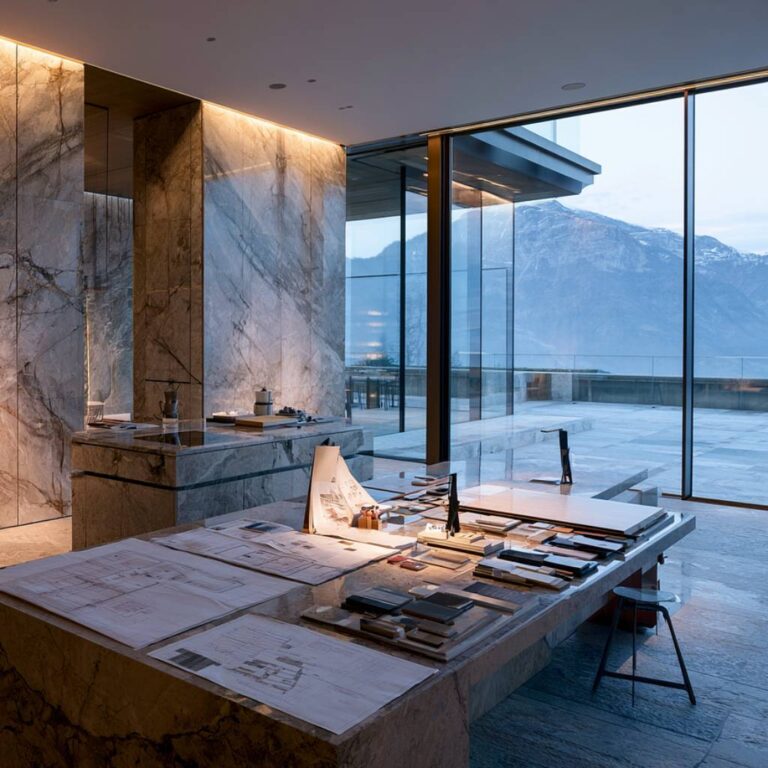

There is a particular kind of failure in architecture that is difficult to name but impossible to ignore. It does not announce itself through cracks, defects, or visible damage. Instead, it reveals itself through discomfort; subtle, persistent, and deeply perceptual. You look at a surface that should feel resolved, and yet your eye refuses to settle.
Everything appears correct. The material is expensive. The detailing is refined. The drawings were followed. And still, something feels off.
This is the kind of failure that does not belong to execution alone. It belongs to the sequence of decisions that led there.
The book matched stone wall is often treated as a symbol of precision. It is expected to deliver symmetry, continuity, and a sense of visual calm that reads as effortless luxury. When done well, it feels inevitable, as if the stone always intended to exist that way. But this inevitability is not natural. It is constructed through discipline.
And when that discipline is missing, the illusion collapses.
The Promise of Bookmatching
Bookmatching is not simply a visual effect. It is a commitment to continuity. Two slabs are placed in mirrored alignment so that their veins form a symmetrical composition, often resembling a natural inkblot or a geological narrative unfolding across a surface.
This is what makes it powerful. The eye does not read it as decoration; it reads it as order.
But that order is fragile. It depends not only on selecting the right slabs, but on understanding them as part of a sequence. Each slab is not an isolated object. It is a fragment of a larger system that must be composed before it is cut, before it is transported, and certainly before it is installed.
When this system is reduced to a visual decision, “this slab looks good” the outcome is already compromised.
Where the Breakdown Begins
In the project this teardown reflects, the intent was not absent. The drawings indicated a book matched wall. The slabs selected were of high quality. The expectation was clear: a symmetrical, continuous surface that would anchor the space.
Yet the final installation told a different story.
The veins did not align as anticipated. The symmetry felt forced, almost approximate. The seams became visible interruptions rather than invisible transitions. The wall, instead of feeling composed, felt assembled; piece by piece, decision by decision.
It is tempting to attribute this to poor workmanship or site error. But that would be an oversimplification.
The failure began much earlier.
The Absence of a Datum
Every composed surface requires a reference. A datum is not just a line on a drawing; it is a decision that anchors all other decisions. It defines where alignment begins, how symmetry is measured, and what remains constant when everything else varies.
In this case, that datum was never clearly established.
Without it, installation became incremental. Each slab was positioned relative to the previous one, rather than to a fixed system. Minor deviations accumulated. Adjustments were made in isolation. And over time, the composition drifted.
This is the paradox of construction: every individual decision can be correct, and the overall outcome can still fail.
The eye does not evaluate slabs individually. It evaluates continuity. And continuity requires a fixed reference that survives every stage of execution.
When Sequencing Fails
The issue was compounded by the sequencing of trims. Metal profiles, intended to frame and resolve the edges of the stone, arrived later than they should have. Their placement was no longer a design decision but a constraint.
Instead of supporting the book match composition, the trims began to dictate it.
Edges were adjusted to accommodate profiles. Slabs were shifted to resolve junctions. What should have been a pre-determined alignment became a reactive process, where each new element forced a recalibration of what had already been installed.
This is where many projects lose their clarity, not through visible mistakes, but through invisible compromises.
Timing, in this sense, is not logistical. It is architectural.
The Illusion of Correctness
What makes this kind of failure particularly challenging is that it often passes unnoticed in isolation. A single slab looks correct. A joint appears acceptable. A detail meets specification.
But architecture is not experienced in fragments. It is experienced as a field.
When the eye scans a surface, it does not pause at each joint to evaluate accuracy. It absorbs the entire composition at once. And within that instant, it detects inconsistencies that are too subtle to measure but too persistent to ignore.
This is why the wall failed the eye test.
Not because it was wrong, but because it was never fully resolved.
Reconstructing the Process
To understand the fix, one must step back from the wall and examine the process that produced it.
A disciplined workflow for book matching begins long before the slabs reach site. It starts with the selection of full slabs, not samples. Each slab is studied for its veining, its direction, and its relationship to adjacent pieces.
These slabs are then mapped onto elevations. Not abstractly, but precisely. Each piece is assigned a position, a sequence, and a role within the overall composition.
Seams are not left to convenience. They are designed. Their placement is determined by the logic of the pattern, not by the limitations of cutting or transport.
Trims are integrated into this system from the beginning. Their dimensions, positions, and junctions are resolved alongside the stone, not after it.
And most critically, this entire system is documented. Drawings are not indicative; they are instructive. They are signed, shared, and enforced.
No installation begins without them.
What Actually Defines Luxury
It is easy to believe that luxury is a function of material. That if the stone is rare enough, expensive enough, or visually striking enough, the outcome will inherently feel refined.
But this project suggests otherwise.
Luxury is not the material. It is the control exercised over that material.
It is the ability to translate intention into execution without distortion. It is the discipline to resolve decisions before they become problems. It is the alignment of design, fabrication, and installation into a single, continuous thought.
When that alignment exists, the result feels effortless. When it does not, even the most premium material cannot compensate.
Conclusion: Where the Wall Actually Failed
The book match wall did not fail because the stone was incorrect. It did not fail because the installers lacked skill. It did not fail because the design was flawed.
It failed because the system that connects these elements was incomplete.
A bookmatch is not created on site. It is not adjusted into place. It is not discovered during installation.
It is decided; deliberately, rigorously, and early.
And when that decision is missing, the wall may still stand. It may still function. It may even look impressive at a glance.
But it will never feel resolved. And the eye will always know.