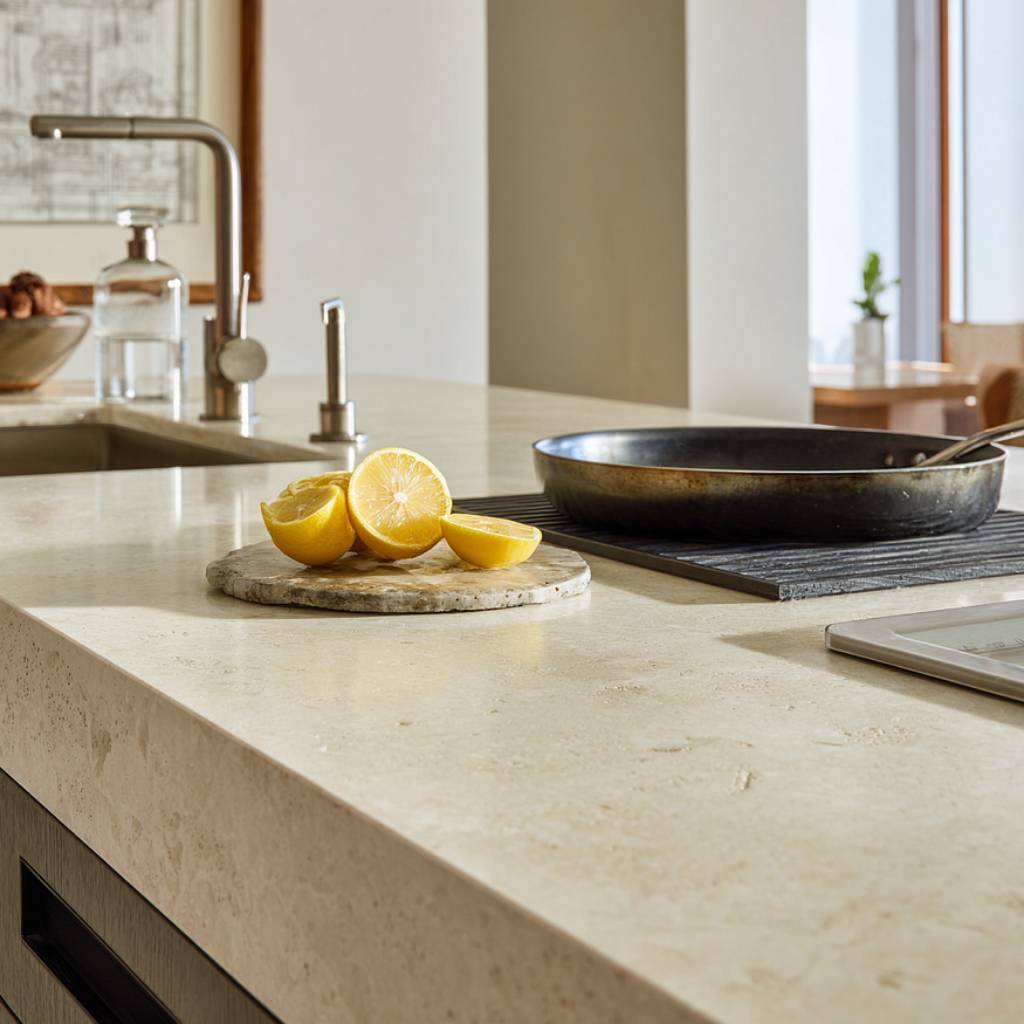
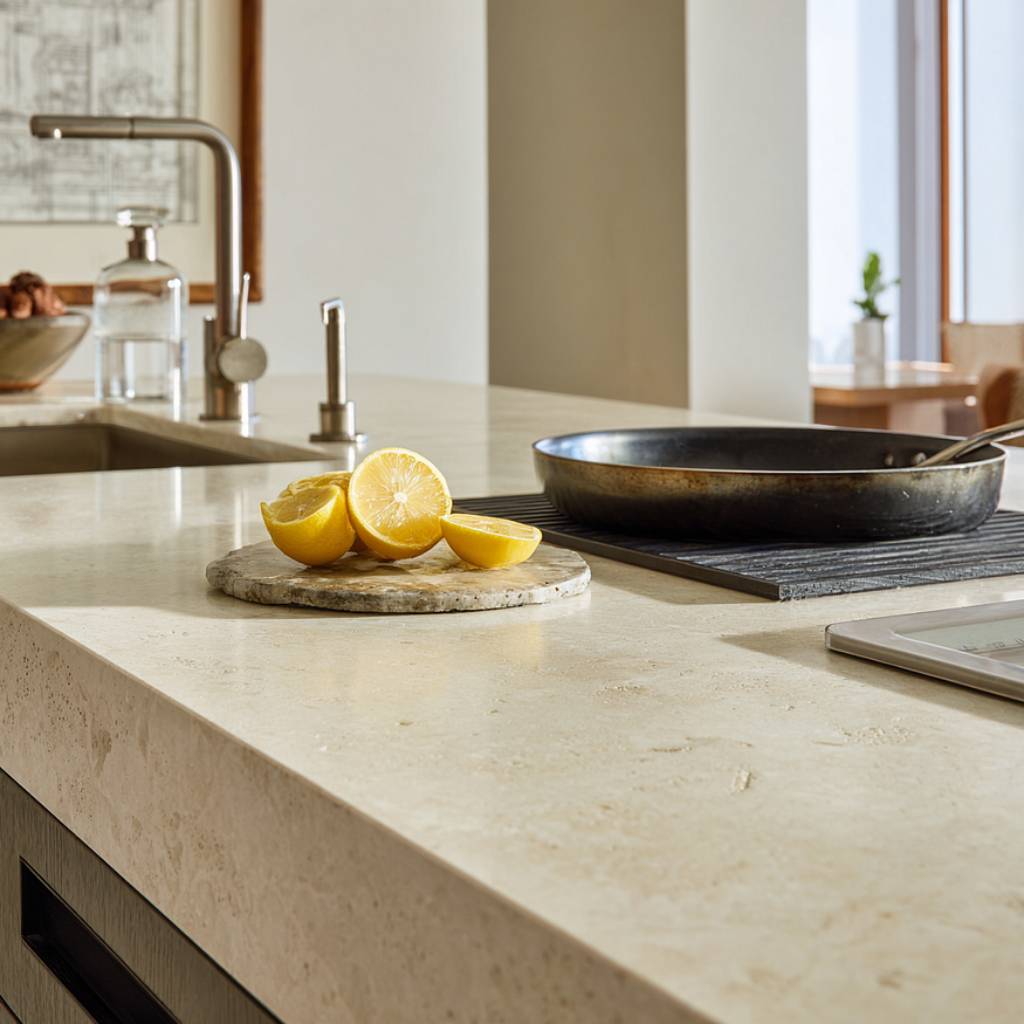
The complaint did not begin with a crack, a stain, or a catastrophic failure. It began with uncertainty. Nearly a year after hand over, the homeowner noticed that the countertop no longer looked the way it had on the day it was installed. A section near the sink appeared dull under evening light. There were faint marks around areas of frequent use. Along one exposed edge, a small chip had become visible enough to attract attention. None of these issues affected the functionality of the countertop, yet they collectively created the impression that something had gone wrong.
As is often the case in luxury residential projects, the immediate assumption was that the material had failed. The countertop had been positioned as a premium surface, carefully selected after multiple rounds of sampling and approval. Expectations were naturally high. When a premium material begins to look different from the way it did at handover, the instinct is to search for a defect. However, the investigation revealed something more interesting. The stone had performed largely as expected. What was missing was not material performance but a framework for understanding it.
The project itself had been meticulously documented. There were approved shop drawings, slab selections, fabrication records, installation photographs, and quality-control sign-offs. Every step required to deliver the countertop had been recorded. Yet among all of this documentation, there was very little information explaining how the surface was expected to behave over time. There was no clear guidance on cleaning products, no explanation of how acidic substances could affect the finish, no maintenance schedule, and no distinction between normal wear and genuine failure. The project had a specification, but it did not have a service plan.
This distinction is more important than it first appears. Countertops are often discussed as design elements, but they function more like working equipment. Few surfaces inside a home are subjected to the same combination of heat, moisture, impact, abrasion, and chemical exposure. Hot cookware is placed directly onto them. Food preparation introduces acids, oils, and pigments. Small appliances create repeated vibration. Water accumulates around sinks and joints. These conditions are not exceptional events. They are the normal operating environment of a kitchen. Yet despite this reality, many projects still treat countertop performance as something that can be guaranteed through material selection alone.
The assumption is understandable. Considerable effort is invested in choosing the material. Discussions typically focus on appearance, pattern, finish, colour consistency, and sourcing. By the time the countertop reaches site, the design team often feels that the critical decisions have already been made. In reality, material selection is only one part of a much larger performance system. The detailing of sink cut-outs, edge profiles, support conditions, sealing strategy, maintenance requirements, and user behaviour all influence how the countertop will age. Ignoring these factors creates a gap between expectation and reality, and it is within this gap that most complaints emerge.
What became evident during the review of this project was that nobody had clearly defined what ownership of the surface actually meant. The contractor assumed the homeowner understood the limitations of the material. The homeowner assumed that premium materials required minimal attention. The supplier assumed maintenance guidance would be communicated by the project team. Each assumption seemed reasonable in isolation. Together, they created a situation in which responsibility for aftercare effectively disappeared.
This is why the absence of a service plan can be more significant than the absence of a technical detail. Technical details govern installation. Service plans govern performance after occupation. They establish realistic expectations, define maintenance responsibilities, explain repair options, and provide guidance on how to respond when issues arise. More importantly, they acknowledge a simple reality that is often overlooked in luxury construction: materials continue to perform long after the project team has left the site.
The most successful projects recognise this. They treat handover not as the end of a process but as the beginning of a new phase in the life of the material. Alongside warranties and completion certificates, they provide practical guidance that explains how the surface should be cleaned, what forms of wear are normal, what constitutes damage, and which issues can be repaired. These documents are rarely complex, but they significantly reduce the likelihood of misunderstandings because they align expectations with reality before problems occur.
Looking back, the countertop itself was never the source of the problem. The stone behaved exactly as stone behaves. The kitchen functioned exactly as kitchens do. The issue arose because nobody had clearly connected the two. A material was specified, installed, and handed over, but its long-term performance was never translated into language the homeowner could understand. As a result, perfectly predictable changes were interpreted as unexpected failures.
Perhaps that is the lesson hidden within many post-handover complaints. Buildings rarely fail because a single decision was made incorrectly. More often, they fail because a critical conversation never happened. In this case, the missing conversation was not about stone, fabrication, or installation. It was about ownership. And that conversation might have been the most important specification of all.