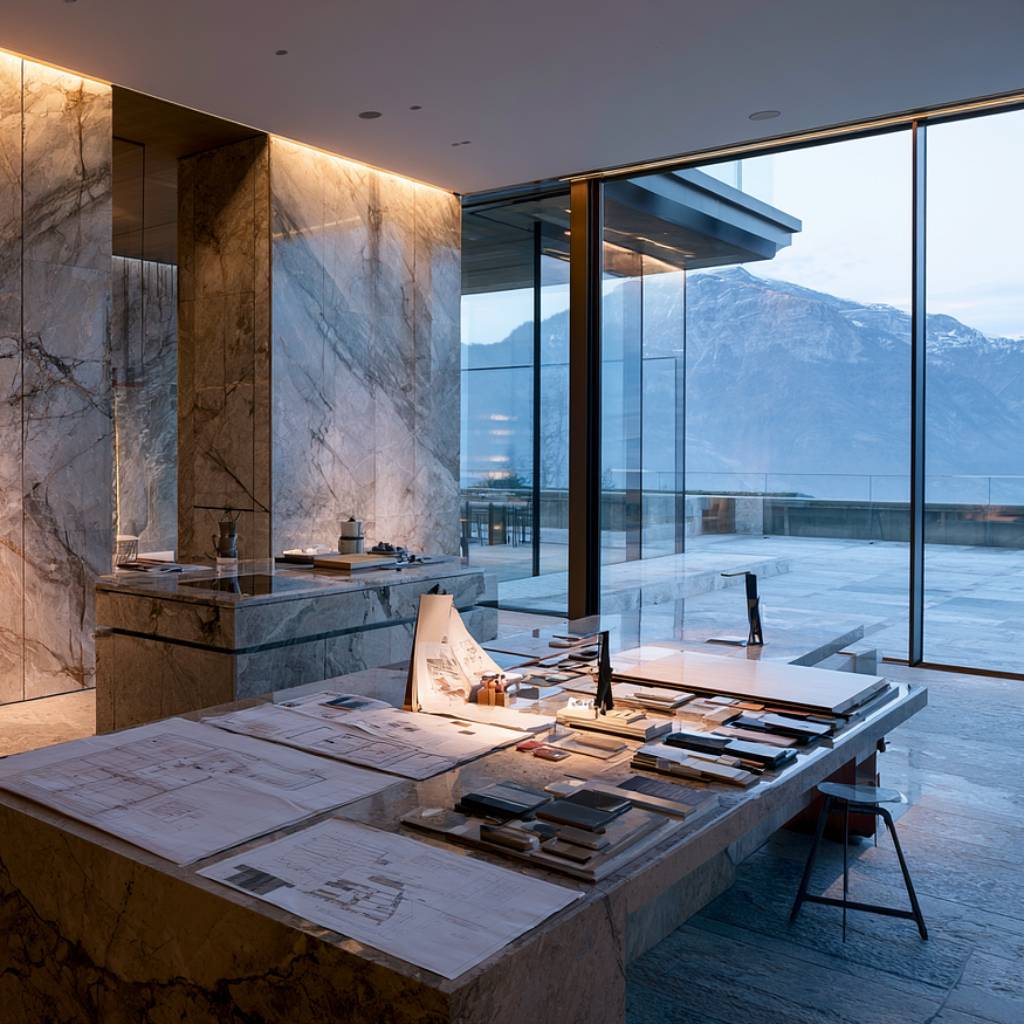
Luxury homes rarely fail because the stone was poorly chosen. They fail because everyone involved in the project interpreted that choice differently.
A marble slab leaves the quarry with a geological identity, but by the time it becomes a kitchen island, staircase, bathroom wall or outdoor terrace, it has passed through dozens of decisions made by architects, interior designers, structural engineers, quantity surveyors, procurement teams, fabricators, installers, contractors and homeowners. Every handoff introduces the possibility of interpretation. Every assumption introduces risk. The finished surface may look flawless on the day of handover, yet the consequences of undocumented decisions often emerge months or years later in the form of cracked edges, staining, uneven joints, colour inconsistencies, water ingress or expensive replacement work.
Luxury construction has long celebrated materials while underestimating documentation. Yet the specification behind a finish is often more valuable than the finish itself. A carefully selected stone can only perform as well as the information that accompanies it. In high-end residential projects, the most expensive failures are rarely installation failures. They are documentation failures that begin long before fabrication starts.
Every project begins with enthusiasm around material selection. Samples are reviewed under showroom lighting, mood boards are assembled, and slabs are reserved from quarries around the world. The design intent appears clear because everyone is looking at the same stone. In reality, they are rarely looking at the same project. The architect is evaluating aesthetics and proportion. The structural engineer is thinking about weight, loading and support. The fabricator is considering slab yield and cutting efficiency. The contractor is focused on sequencing and programme. The installer is concerned with tolerances, adhesives and access. The facilities team is already thinking about long-term maintenance. Each discipline views the same material through a different technical lens.
Without a single document that aligns these perspectives, coordination begins to depend on conversations rather than decisions. Verbal agreements replace measurable requirements. Emails become substitutes for specifications. Shop drawings attempt to resolve issues that should have been defined weeks earlier. By the time discrepancies appear on site, every correction is significantly more expensive than the decision would have been during design.
This is why leading international practices increasingly treat the stone specification sheet not as procurement paperwork but as a coordination document. Its purpose is not simply to identify a material. It is to translate design intent into buildable, measurable and maintainable information that every participant understands in exactly the same way.
A robust luxury stone specification does far more than record the stone’s commercial name. It establishes its geological classification, country of origin, approved quarry, slab batch requirements and acceptable variation limits. These details become particularly important when projects require additional material months after initial procurement. Without documented acceptance criteria, replacement slabs often differ in colour, veining or mineral composition, leading to visually fragmented installations that were never intended by the design.
Surface finish is another area where assumptions routinely become defects. A specification that simply states “honed marble” leaves considerable room for interpretation. The degree of honing, gloss level, surface texture, edge profile and polishing sequence all influence appearance, slip resistance, maintenance requirements and long-term performance. Interior and exterior applications may require entirely different finishes even when using the same stone. Without precise documentation, fabricators and installers often rely on standard industry practice rather than project-specific intent.
Installation methodology deserves equal attention. Stone performance depends as much on the substrate as on the slab itself. Moisture movement, structural deflection, thermal expansion and adhesive compatibility all determine whether the installation remains stable over decades. Large-format slabs require different handling methods from conventional tiles. Mechanical fixing may be essential for certain vertical applications. Exterior paving demands carefully designed drainage falls, movement joints and bedding systems. When installation methods remain undocumented, contractors frequently default to familiar practices that may not suit the material or the environmental conditions.
Movement joints illustrate how invisible decisions determine visible outcomes. Designers often pursue uninterrupted stone surfaces to create visual calm, yet every building continues to move throughout its life. Concrete shrinks. Steel expands. Temperature fluctuates. Moisture levels change. Stone itself experiences dimensional movement. A specification that ignores joint locations in pursuit of seamless aesthetics effectively transfers the problem into the future, where it reappears as cracking, tenting or debonding. Good documentation acknowledges that movement is inevitable and designs for it rather than pretending it does not exist.
Quality control should also begin long before installation. One of the most effective risk management tools in luxury residential construction is the full-scale mock-up. Rather than evaluating isolated material samples, mock-ups test the complete assembly. They reveal interface conditions, lighting behaviour, joint widths, edge treatments, transitions, fixing systems and workmanship standards under realistic site conditions. Once approved, the mock-up establishes an objective benchmark for the remainder of the project. Without this reference, quality becomes subjective, and disputes become almost inevitable.
Acceptance criteria are another frequently overlooked component of specification writing. What constitutes an acceptable variation in veining? How much lippage between adjacent slabs is permissible? Which natural characteristics are expected, and which qualify as defects? How will repaired areas be evaluated? Who signs off each stage before fabrication proceeds? If these questions remain unanswered until completion, disagreements shift from technical evaluation to commercial negotiation. Projects begin debating opinions rather than verifying documented standards.
Maintenance planning is equally critical, particularly in luxury homes expected to perform for generations. Different stones require different cleaning products, sealing schedules, polishing methods and repair procedures. Yet maintenance information is often assembled only during handover, long after procurement and installation decisions have been finalised. By integrating maintenance requirements into the original specification, designers ensure that material selection reflects the realities of ownership rather than the excitement of presentation day.
Perhaps the greatest value of a one-page luxury stone specification lies not in the information it contains but in the conversations it forces before work begins. It encourages architects, consultants, fabricators and contractors to resolve uncertainties during design rather than during construction. It transforms assumptions into documented decisions and replaces interpretation with coordination. In doing so, it protects not only the appearance of a project but also its programme, budget and long-term performance.
Luxury construction is often associated with extraordinary materials sourced from exceptional places. Yet materials alone have never guaranteed exceptional buildings. A rare marble extracted from the Italian Alps or a precisely book-matched limestone wall carries little value if the decisions governing its installation remain undocumented. True luxury is not defined by what is purchased. It is defined by the discipline with which every decision is recorded, coordinated and executed.
The finest homes are remembered not because they used remarkable stone, but because every professional involved shared the same understanding of how that stone should perform. In luxury construction, the specification sheet is not administrative paperwork. It is the first built element of the project.
Decision to be taken:
Should the project establish a single, comprehensive stone specification before procurement and fabrication begin?
Risk if Ignored:
Misaligned expectations between architects, suppliers, fabricators and contractors can result in incorrect finishes, installation disputes, costly rework, programme delays, premature failures and inconsistent long-term performance.
Best Stage to Decide
Design Development, with final validation before Procurement.
Decision Owner
Architect, Interior Designer, Stone Consultant, Project Manager and Fabricator working collaboratively.
Long-Term Impact
Higher construction quality, predictable installation, reduced maintenance, improved durability, controlled costs and a more consistent user experience throughout the building’s lifecycle.
Key Lesson
The most valuable stone document is not the purchase order, it is the specification that ensures every decision is understood before the first slab is ever cut.