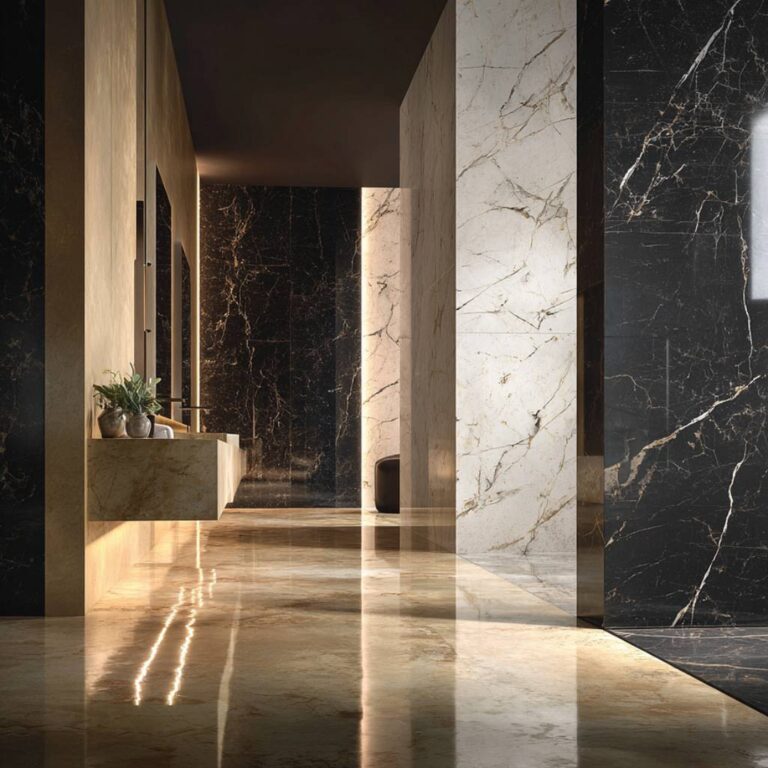
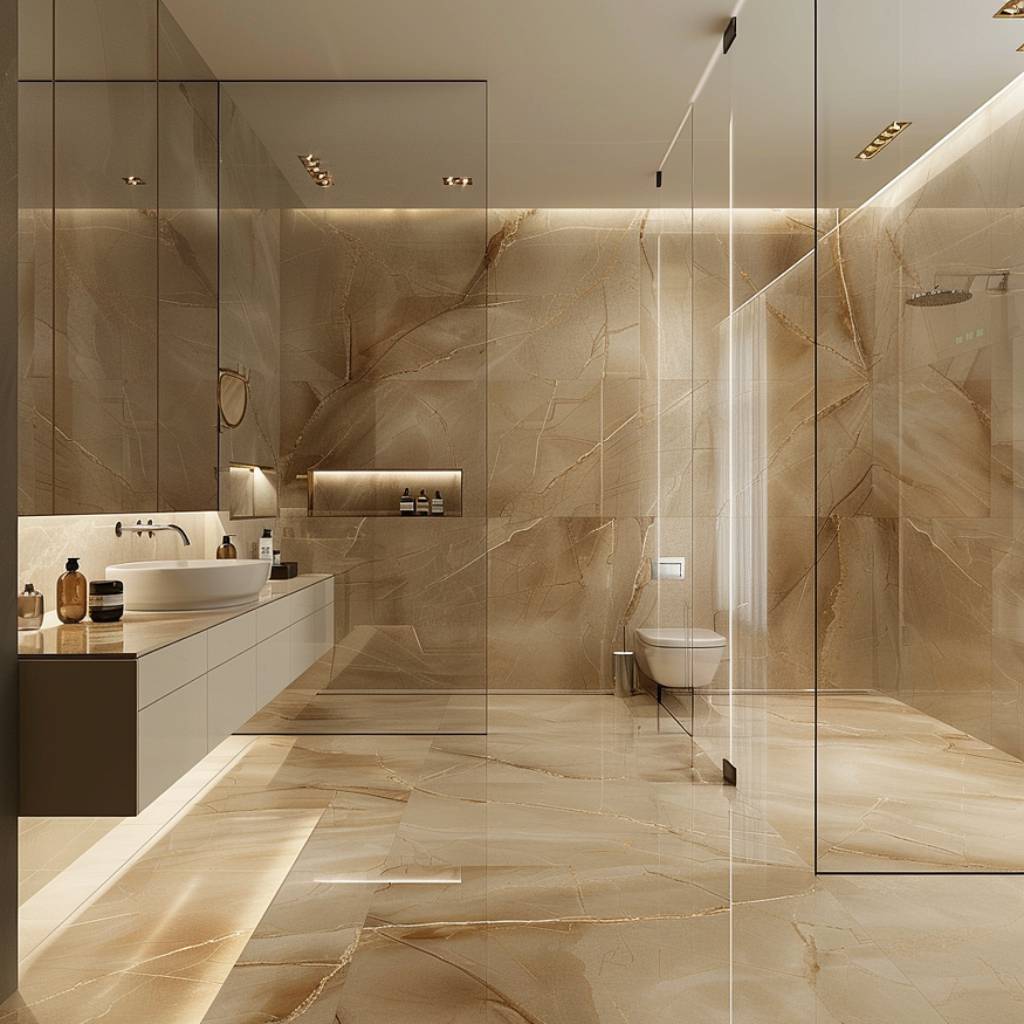
In wet areas, stone does not perform on its own, it performs as part of an assembly. Yet most failures in luxury bathrooms are not caused by the stone itself, but by the invisible layers beneath it. A beautifully finished marble floor or wall may look flawless at handover, but over time, issues like staining, debonding, efflorescence, or persistent damp patches begin to appear. These are not random defects; they are predictable outcomes of incomplete planning across the system. Waterproofing, slope-to-drain, adhesive compatibility, grout and sealant strategy, and even the absorption behavior of the stone must work together. When one layer is treated in isolation, the entire assembly becomes vulnerable.
The most common breakdown begins at the waterproofing stage. Membranes are often applied as a checklist item rather than a performance system. In many cases, terminations at drains, corners, and upturns are poorly executed or not inspected before being covered. Once the stone is installed, these hidden discontinuities become impossible to access. Water finds its way through the weakest interface, typically the transition between drain and membrane or at poorly sealed junctions and begins to accumulate within the build-up. Without a verified slope directing water efficiently to the drain, moisture lingers, increasing hydrostatic pressure and eventually expressing itself through grout lines or stone pores.
Slope, in fact, is one of the most underestimated variables. A floor that appears visually level may still be functionally incorrect. Even minor deviations can cause water to stagnate, especially in large-format stone installations where fewer joints mean fewer escape paths. Over time, this stagnation leads to discoloration, microbial growth, and deterioration of adhesives. The issue is not visible on day one, which is why it is often ignored during installation. But performance in wet areas is defined not by appearance at completion, but by behavior over time.
Another critical factor is material compatibility. Adhesives, grouts, sealants, and waterproofing systems must be selected as a coordinated set, not as independent products. Incompatible materials can trap moisture, restrict vapor movement, or fail under cyclical wetting and drying conditions. For example, a dense, low-absorption stone paired with an adhesive that lacks flexibility or breathability can lead to bond failure. Similarly, improper sealant selection at movement joints can result in cracking or loss of elasticity, allowing water ingress at critical points.
What ties all of this together is sequencing and responsibility. In many projects, waterproofing, stone installation, and finishing are handled by different teams with limited coordination. Each completes their scope, but no one verifies the performance of the system as a whole. This fragmentation is where most high-end failures originate. An integrated workflow: where waterproofing, fabrication, and installation are aligned under a single quality assurance process significantly reduces risk. Inspection checkpoints must be built into the sequence: membrane testing before covering, slope verification before stone laying, joint detailing before sealing, and final water testing before handover.
Ultimately, wet-area stone failures are not about craftsmanship alone, they are about decisions made too late or not at all. Expensive surfaces do not fail because they are weak; they fail because they inherit unresolved issues from the layers below. A disciplined approach that prioritizes assembly thinking over surface thinking is what separates projects that age well from those that degrade prematurely. In wet areas, performance is designed long before the stone is installed.