For a long time, sustainability conversations in residential architecture occupied an unusual space. Everyone agreed it was important, yet very few people could clearly explain what it meant in practice. Materials were described as natural, responsibly sourced, environmentally conscious, or sustainable, often without any mechanism for verifying those claims. The discussion relied heavily on trust. If a supplier said a product was responsibly produced, the statement was generally accepted. If a material was perceived as natural, it was often assumed to be environmentally preferable. Few clients questioned the details because the industry itself rarely demanded them.
That situation has changed considerably over the last decade, particularly within high-end residential projects where documentation standards continue to become more rigorous. What was once a conversation built on assumptions is increasingly becoming a conversation built on evidence. Architects, consultants, developers, and private clients are asking questions that extend well beyond appearance, durability, and cost. They want to know where materials originate, how they are processed, what environmental impacts are associated with their production, and whether any of those claims can be independently verified.
Stone occupies an interesting position within this shift. Unlike many manufactured materials, stone benefits from a perception of authenticity. It is natural, geological, and often associated with permanence. Many clients instinctively view stone as a responsible choice because it comes directly from the earth rather than from a factory. Yet the journey between a quarry and a completed project is considerably more complex than the finished surface suggests. Extraction, transportation, processing, finishing, packaging, and installation all contribute to the overall environmental profile of the material. Understanding those impacts requires more than visual inspection. It requires documentation.
This is one of the reasons Environmental Product Declarations, commonly known as EPDs, have become increasingly visible within luxury specifications. Their growing importance is not necessarily because project teams have become more environmentally conscious overnight. Rather, they have become more conscious of the need for comparable information. An EPD does not tell a project team which material to select. It does not certify that a product is sustainable. What it does provide is a standardised method for reporting environmental impacts across a product’s lifecycle. It transforms broad claims into measurable data and allows decisions to be made using a common framework rather than marketing language.
The distinction is important because sustainability discussions often become confused by the expectation that documentation should provide simple answers. In reality, the value of an EPD lies in its ability to create transparency. Much like a financial statement, it does not determine whether a business is successful. It provides information that allows others to make informed judgments. Two stone products may both possess EPDs while presenting very different environmental profiles. The document itself is not the conclusion. It is the basis upon which conclusions can be formed.
A similar shift is occurring through the adoption of Health Product Declarations, or HPDs. While environmental impacts tend to dominate public sustainability discussions, material composition has become increasingly relevant as clients pay greater attention to indoor environmental quality. Modern projects frequently evaluate not only the visible material but also the treatments, coatings, sealers, adhesives, and supporting products that accompany it. Questions that were once considered niche are becoming standard. What ingredients are present? Are any substances known to present health concerns? Can the information be disclosed transparently? HPDs attempt to answer these questions by creating a consistent framework for ingredient reporting.
What is particularly interesting is how these documents are changing the definition of luxury itself. Historically, luxury was associated with scarcity, craftsmanship, scale, and exclusivity. Today, transparency is becoming part of that equation. Increasingly sophisticated clients are not satisfied with knowing that a material is rare or beautiful. They want to understand its origins. They want to know how it was produced. They want confidence that the story attached to the material can withstand scrutiny.
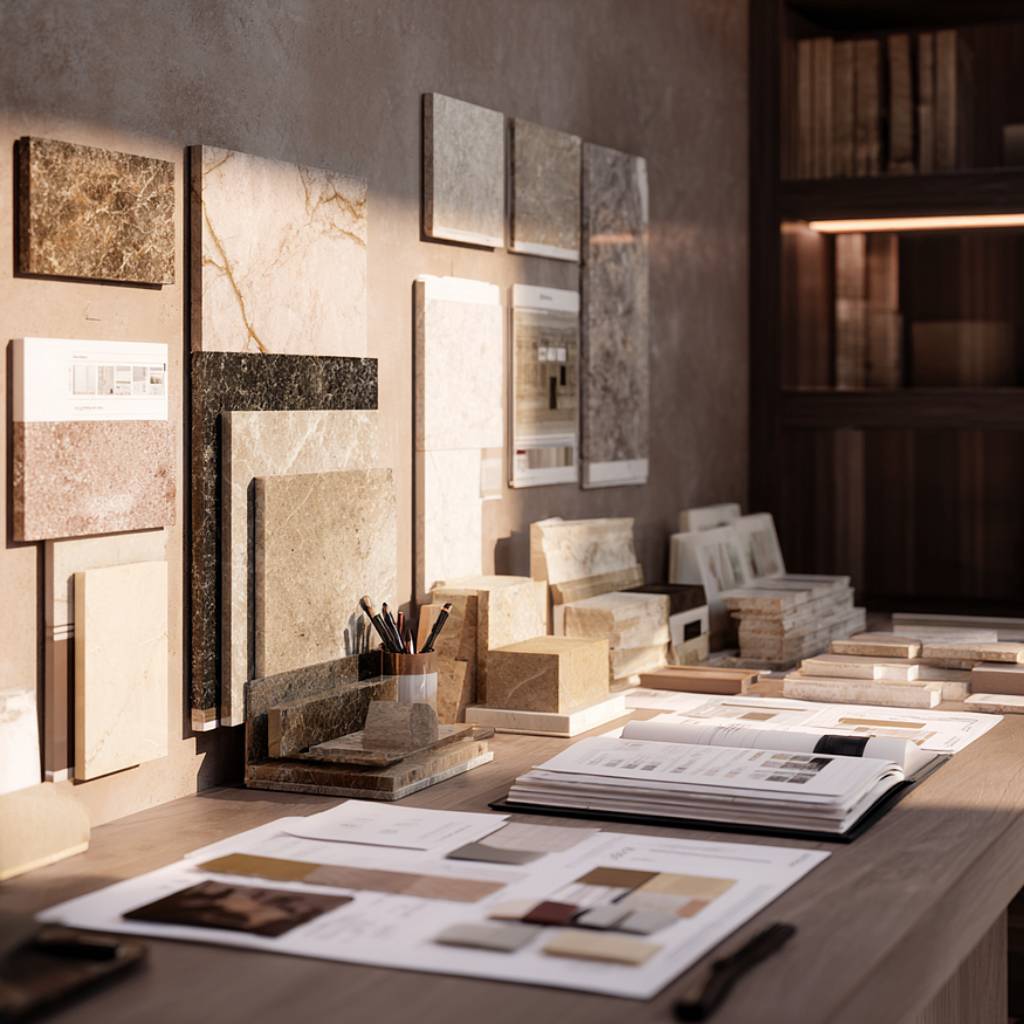
This shift is perhaps most visible during the specification process. A decade ago, discussions about stone selection often ended once the aesthetic direction had been agreed. Today, many consultants request documentation alongside physical samples. Questions about quarry locations, extraction practices, processing facilities, and third-party certifications now sit alongside discussions about colour and finish. The material is no longer evaluated solely as an object. It is evaluated as part of a system.
ANSI/NSI standards reflect this evolution particularly well. Unlike promotional claims that originate from within the supply chain, these standards introduce external benchmarks against which practices can be assessed. They address issues ranging from environmental stewardship to workplace conditions and operational transparency. Their importance lies not in providing a perfect measure of sustainability but in establishing a recognised framework through which performance can be evaluated.
What makes this development significant is that it moves sustainability away from aspiration and toward accountability. Architecture has always been comfortable discussing intentions. Verifying outcomes has often been more difficult. Documentation creates a bridge between the two. It allows project teams to move beyond statements about responsibility and begin examining the evidence supporting those statements.
The broader implication is that sustainability is gradually becoming less about individual products and more about information quality. The question is no longer whether a stone supplier claims responsible sourcing. The question is whether the claim can be substantiated through recognised documentation. The conversation is becoming less subjective and more transparent.
Perhaps that is the most important change taking place. The future of material specification is unlikely to be defined by stronger sustainability narratives. It will be defined by stronger sustainability evidence. As expectations continue to rise, beauty alone will no longer be enough to secure a place within premium projects. Materials will increasingly be asked to explain themselves, not just aesthetically but operationally.
In that environment, documents such as EPDs, HPDs, and ANSI/NSI certifications become more than administrative requirements. They become part of the specification itself. They provide a means of understanding what lies behind the surface and create a level of transparency that luxury projects are beginning to expect as standard.
The stone may still be selected because it is beautiful. Increasingly, however, it will remain selected because its story can be verified.